
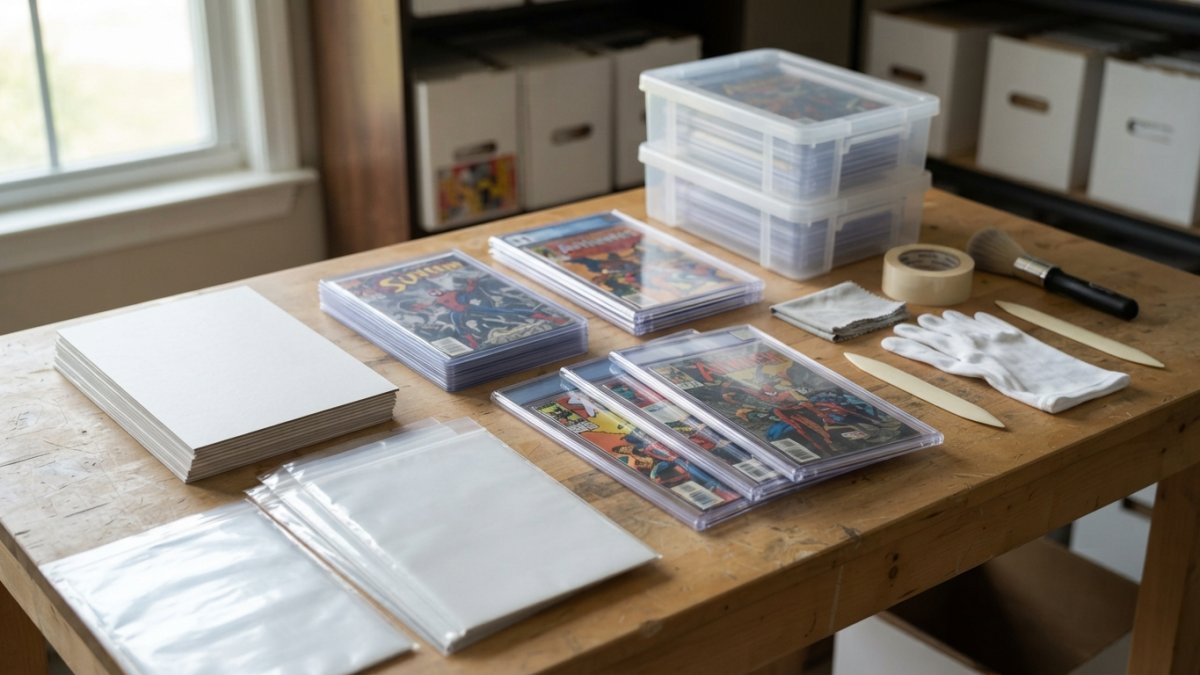
Table of Contents
- What to Look for in Comic Cover Protection Supplies
- Comic Book Bags and Boards: The Everyday Standard
- Mylar Comic Bags: Archival Protection Worth the Cost
- Hard Comic Book Protectors: Top Loaders and Magnetic Holders
- Protecting Foil Comic Covers and Specialty Finishes
- Display vs. Long-Term Storage: Matching Protection to Use
- Cost Per Comic and Ownership Trade-Offs
- Frequently Asked Questions
Last Updated: October 19, 2026
What to Look for in Comic Cover Protection Supplies
The right comic cover protection comes down to three variables: material safety, correct fit, and how much handling the book will see. At Comics and Collectibles R Us, we have spent over 40 years handling books that range from dollar-bin readers to five-figure grails, and the same rule holds at every price point: the wrong sleeve can do more damage than no sleeve at all.
Comic cover protection is the practice of enclosing a comic in a chemically stable sleeve and rigid support so the cover, spine, and corners stay free of handling wear, moisture, and light damage. That definition matters because the market is full of products that protect against one threat while quietly causing another.
Material Safety and Long-Term Preservation
Material safety is the single most overlooked factor in buying protection supplies. Sleeves made from PVC, a plastic still found in older and discount products, can break down over time and release plasticizers that migrate into paper. The result is a sticky residue, yellowed covers, and a book that grades lower than it should.
Archival-grade materials, by contrast, are designed for decades of contact with paper. When collectors ask us what to buy first, we tell them to spend on the sleeve material before anything else.
Sizing and Fit: Modern, Silver-Age, and Golden-Age Comics
Fit is where most buyers get burned. Current-size comics, roughly the standard modern trim, need a different bag than a silver-age or golden-age book, which are typically slightly wider and taller. A bag that is too tight bends corners during insertion; one that is too loose lets the book slide and scuff.
- Modern and current-size: standard current bags and boards
- Silver-age: slightly larger bags sized for the older trim
- Golden-age and hardcover: oversized bags, often sold as magazine or golden-age sizes
- Annuals and thicker books: check spine width before ordering
Always measure the book itself rather than trusting the label. A quarter-inch of clearance on each side is a sensible target.
Comic Book Bags and Boards: The Everyday Standard
Comic book bags and boards are the default protection for most collections, and for good reason. A poly bag paired with an acid-free backing board keeps dust off the cover, supports the spine, and costs little per book. This is the setup we recommend for anything headed into a short box for regular reading or moderate-term storage.
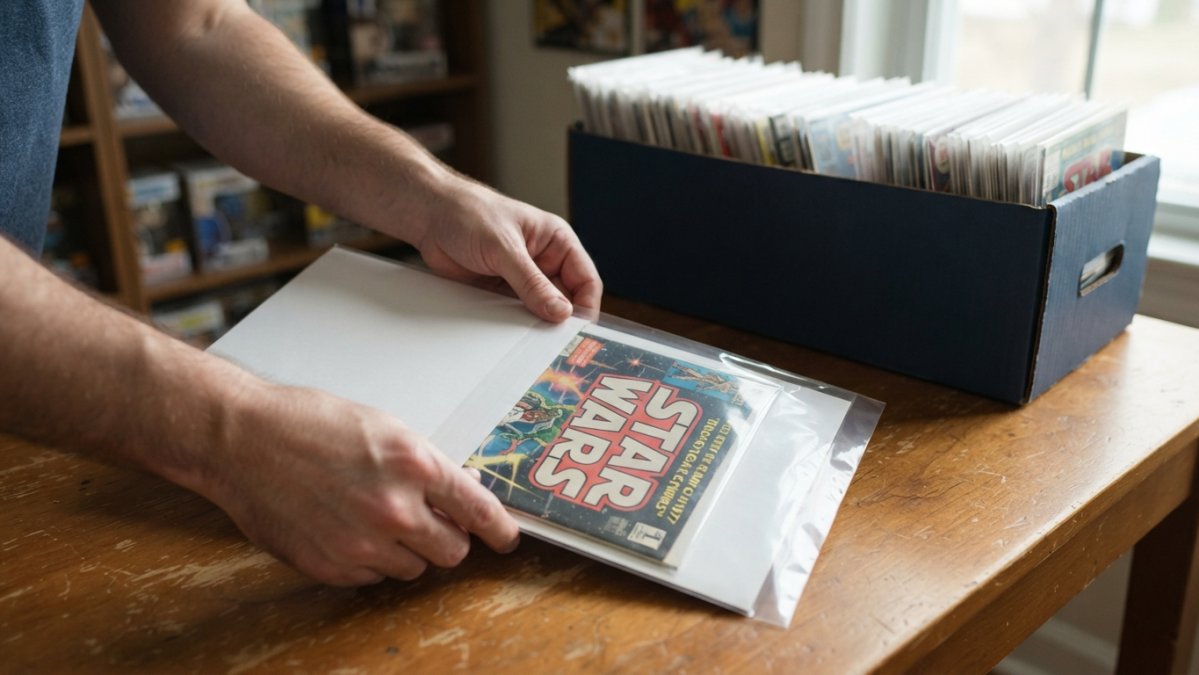
The board matters as much as the bag. A thin, acidic board can leach into the back cover over years, so look for boards labeled acid-free and buffered.
Polypropylene vs. Polyethylene Bags
Polypropylene and polyethylene are the two common bag plastics, and the difference is practical rather than academic. Polypropylene bags are clearer and stiffer, which makes covers look sharp on a shelf. Polyethylene bags are softer and more pliable, which some collectors prefer for older or fragile books.
Neither is archival in the way Mylar is, but both are safe for everyday use when sold as acid-free. Replace them every few years if you live in a humid climate.
Backing Board Thickness and Acid-Free Options
Backing board thickness is usually described in points, and thicker boards resist bending better. Standard boards suit most modern books; thicker boards help with oversized or heavy annuals. Whatever the thickness, confirm the board is acid-free and buffered before it touches a book.
Mylar Comic Bags: Archival Protection Worth the Cost
Mylar comic bags are the archival standard, and they are the right call for any book you intend to hold for decades or display. Mylar, a polyester film, is chemically inert and does not off-gas the way cheaper plastics can. It costs more per sleeve, but for a prized comic the premium is easy to justify.
The trade-off is real: Mylar is stiffer, so it takes more care to insert a book without catching a corner. Use a backing board as a ramp and slide the book in slowly.
Hard Comic Book Protectors: Top Loaders and Magnetic Holders
Hard comic book protectors add rigidity that bags cannot match. Top loaders are rigid sleeves open on one end, ideal for shipping, transport, and protecting a book you handle often. Magnetic holders sandwich a comic between two rigid panels with a magnetic closure, and acrylic holders do the same job with a cleaner display look.
- Top loaders: best for shipping and short-term handling
- Magnetic holders: best for display and frequent access
- Acrylic holders: best for a premium shelf or wall presentation
None of these replace a proper sleeve and board inside them. The rigid shell protects against impact; the inner sleeve protects against chemistry.
Protecting Foil Comic Covers and Specialty Finishes
Protecting foil comic covers takes extra care because the finish itself is fragile. Foil, metal, and embossed covers scratch easily, and fingerprints show up on a glossy surface far more than on standard stock. Handle these books by the edges only, and never slide one across a rough surface.
For foil variants, we suggest a fresh, clean sleeve and a rigid holder for anything on display. Avoid stacking heavy books directly on top of a foil cover, and keep the book out of direct light, since prolonged light exposure can dull a metallic finish over time.
Display vs. Long-Term Storage: Matching Protection to Use
Display and long-term storage are different jobs, and matching the protection to the use is what separates a well-kept collection from a damaged one. Display protection prioritizes clarity and rigidity. Long-term storage prioritizes chemical stability and a controlled environment.
Short Boxes, Storage Boxes, and Environmental Conditions
A short box holds roughly a hundred bagged comics and is easier to move than a long box, which makes it the better choice for most collectors. Storage boxes should be kept off the floor, away from exterior walls, and out of attics and basements where humidity swings.
Environmental conditions do more damage than most collectors realize. Heat, damp, and direct sunlight all accelerate wear, so keep the collection in a cool, dry room with stable temperature and low light exposure.
| Use Case | Protection Setup | Why It Fits |
|---|---|---|
| Everyday reading | Poly bag + acid-free board | Low cost, easy access |
| Long-term hold | Mylar bag + buffered board | Chemically stable for decades |
| Display | Magnetic or acrylic holder | Rigid, clear, presentable |
| Shipping | Top loader + inner sleeve | Impact protection in transit |
| Foil or metal covers | Fresh sleeve + rigid holder | Guards a fragile finish |
Cost Per Comic and Ownership Trade-Offs
Cost per comic is the metric that actually matters when you are protecting a large collection, and it is the framework most buying guides skip. Poly bags and boards are the cheapest per book, Mylar costs more up front but lasts far longer, and rigid holders are the most expensive and usually reserved for display pieces or high-value books. The ownership trade-off is straightforward: spend the least on books you read and flip, and spend more on the books you plan to keep.
Build the Math Yourself
Prices move with pack size, material, and retailer, so the durable skill is the formula, not a fixed number. For any supply, divide the pack price by the number of sleeves or boards in the pack to get cost per book, then divide again by the expected years of service to get cost per book-year.
- Poly bag plus acid-free board: lowest cost per book, but plan to replace bags every few years, especially in humid conditions.
- Mylar bag plus buffered board: higher up-front cost per book, but the sleeve is chemically stable and does not need routine replacement, so the per-year cost narrows over a long hold.
- Top loader: moderate cost, reusable across many books, best counted as a shipping and handling expense rather than a storage one.
- Magnetic or acrylic holder: highest cost per book, justified only when display or frequent access is the point.
A common pattern among long-term collectors is to run the numbers on a ten-year horizon. A cheap bag replaced three times can cost more in labor and risk than one archival sleeve bought once, even though the archival sleeve looks expensive at the register.
Match Protection to Value and Intent
| Book type | Sensible setup | Why the spend is proportionate |
|---|---|---|
| Reader copy, dollar bin | Poly bag + acid-free board | Protects against handling at the lowest cost |
| Mid-value key, long hold | Mylar bag + buffered board | Chemical stability for decades |
| High-value grail | Mylar + buffered board inside a rigid holder | Layers chemistry and impact protection |
| Display piece | Magnetic or acrylic holder | Clarity and rigidity are the job |
| Shipping or moving | Top loader + inner sleeve | Reusable impact protection |
The Hidden Costs Buyers Forget
- Labor: rebagging a large collection takes hours; fewer replacements is a real saving.
- Access: a holder you avoid opening because it is fiddly defeats its purpose.
- Capacity: short boxes hold roughly a hundred bagged comics, so storage cost scales with collection size.
- Risk: under-protecting a key issue risks a grade drop that costs far more than the supplies ever would.
If you are unsure of current pricing, check our website or ask our team for a quote, since costs vary with pack size and material. The point is to compare on cost per book-year and protection level, not on the sticker price of a single pack.
Frequently Asked Questions
What supplies do you need to protect comic books?
At minimum, you need a protective sleeve and an acid-free backing board for each comic. For valuable or oversized books, add hard comic book protectors or Mylar comic bags. Store the bagged and boarded comics upright in a short box or storage box, away from sunlight, heat, and moisture. For display, use UV-filtering cases and rotate books periodically to limit light exposure.
Are Mylar comic bags better than polypropylene comic bags?
Mylar (polyester) bags cost more per bag but last decades without yellowing, wrinkling, or off-gassing. Polypropylene bags are cheaper and fine for modern comics you plan to rebag every few years. For silver-age, golden-age, or high-value variants, Mylar comic bags are the safer long-term choice. Whichever you pick, pair the bag with an acid-free backing board and replace any bag that shows clouding or creases.
Do comic books need both a bag and a backing board?
Yes. The bag keeps dust, moisture, and handling oils off the cover, while the backing board adds rigidity that prevents spine roll, corner dings, and bending. A bag alone leaves the comic floppy; a board alone exposes the cover to scratches. Together they form the standard protection level for everyday storage. For extra rigidity, place the bagged and boarded comic inside a hard comic book protector or top loader.
How do you protect foil and embossed comic covers?
Foil and embossed covers scratch easily and show fingerprints, so handle them by the edges and wear nitrile gloves if possible. Use a crystal-clear, acid-free bag with a backing board, and avoid stacking heavy books on top. For display, choose a UV-filtering acrylic holder or magnetic case that keeps the surface untouched. Keep foil covers out of direct light, since glare hides fine scratches and UV can dull the metallic finish over time.